16
How to Date a Vintage Jacket in Ireland: A Collector's Guide
Vintage Jacket Era Estimator
Use this tool to narrow down the age of your find by selecting the specific features you observe on the jacket.
You’ve just dug through a bin at a charity shop on Dublin’s O’Connell Street or rummaged through a stall at the Galway Market and found a leather bomber that looks like it stepped straight out of a 1950s film. It feels heavy, smells faintly of mothballs and old tobacco, and has that perfect worn-in patina. But how do you know if it’s a genuine 1950s treasure or a clever reproduction from the 1990s? Dating a vintage jacket is part detective work, part history lesson. If you’re hunting for authentic pieces in Ireland’s second-hand scene, you need to look past the style and focus on the hardware, the labels, and the construction details. Here is exactly how to tell how old your find actually is.
Check the Zipper Hardware First
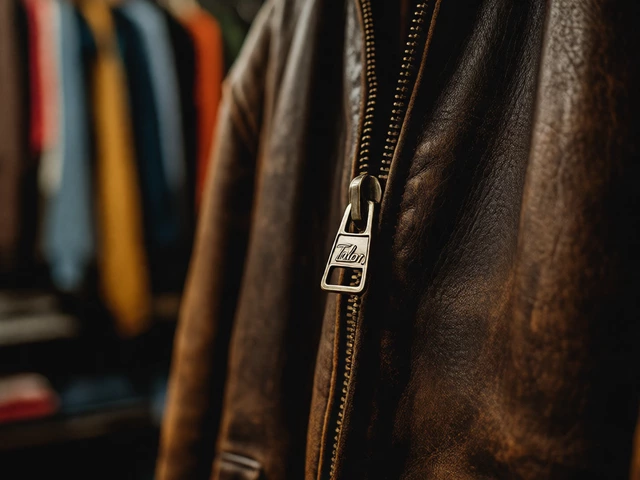
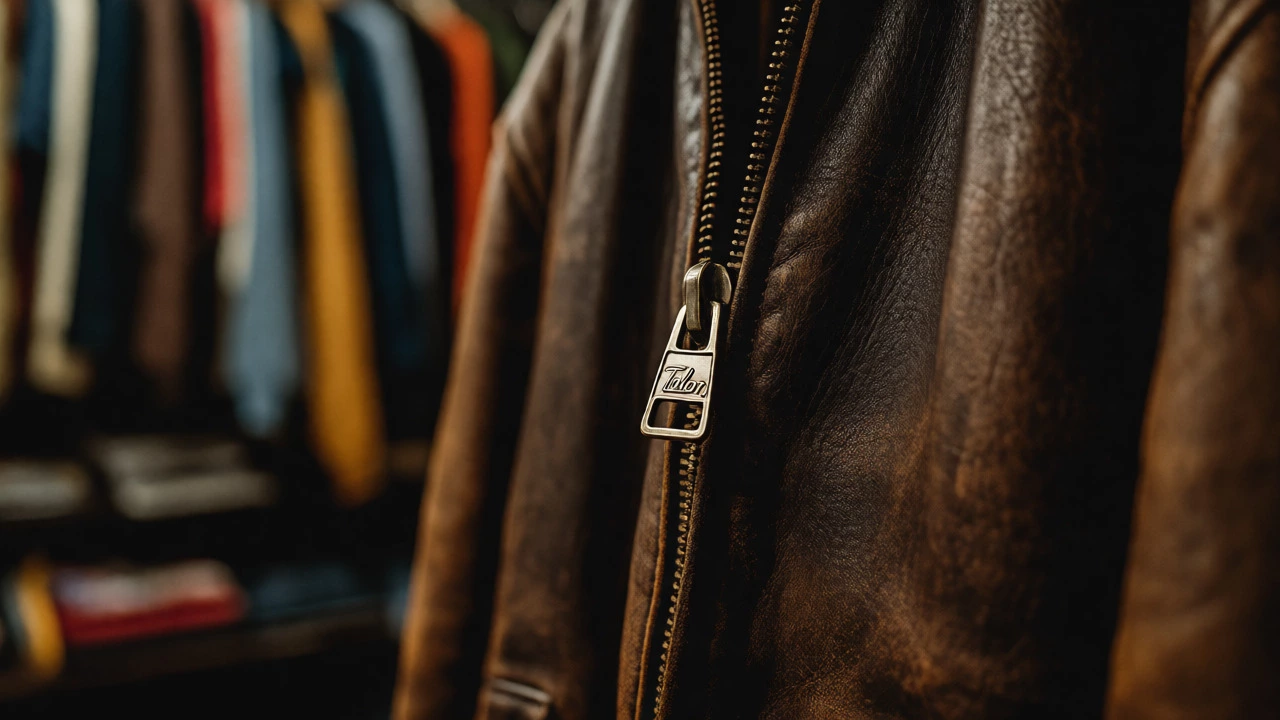
The zipper is often the most reliable indicator of age because manufacturers changed their designs frequently. In Ireland, where we have a strong culture of upcycling and reusing garments, understanding these mechanics saves you money. Look closely at the pull tab. If it says "Talon," you are likely looking at something made before 1960. Talon was the dominant brand in the US and widely exported to Europe until they lost market share to YKK. If you see a zipper with no brand name at all, it might be very early (pre-1930s) or a cheap modern import. However, most unbranded zippers on mid-century jackets are simply worn off.
YKK became the global standard later. If your jacket has a clear, crisp YKK logo on the zipper tape, it is almost certainly post-1970s. Before that, YKK existed but wasn’t ubiquitous in Western outerwear. Another clue is the material. Metal teeth were standard until the late 1950s when plastic molded teeth began appearing. If you have a nylon coil zipper, you are looking at something from the 1960s onwards. In local markets like the one in Cork City, sellers often mislabel 1980s synthetics as 'retro,' so checking the zipper type instantly narrows down the decade.
Decode the Care Labels and Tags
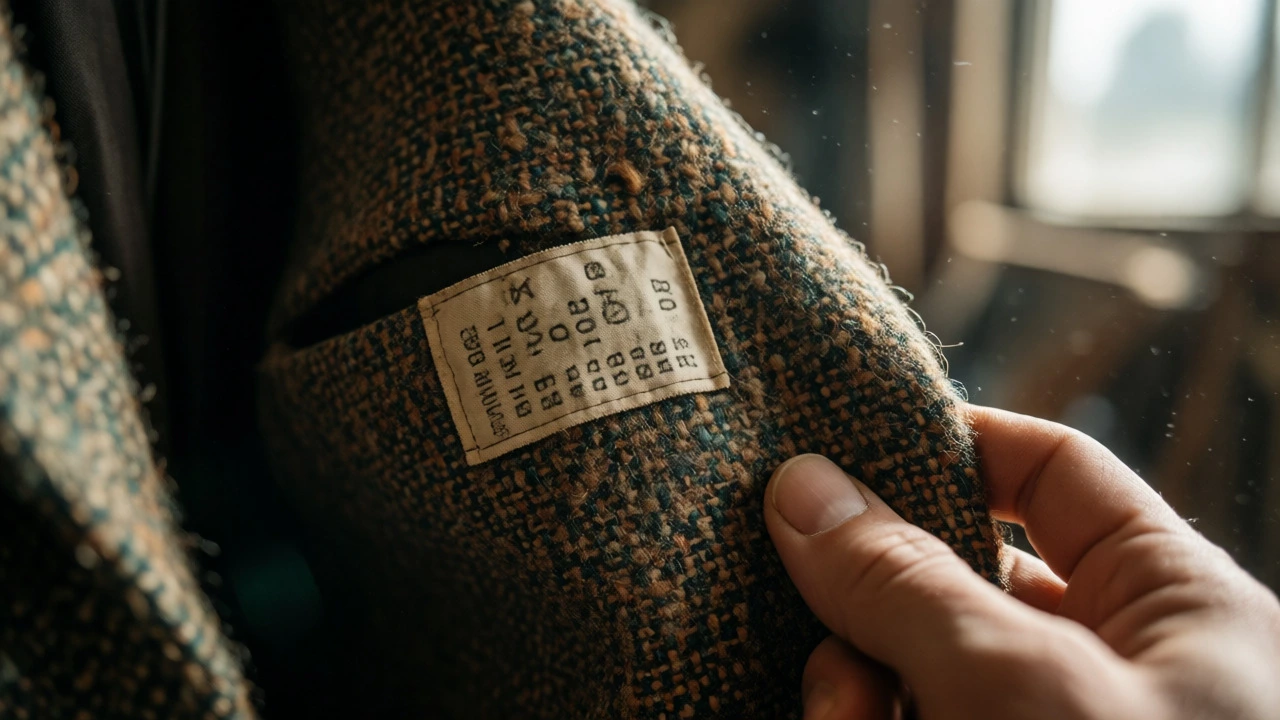
Care labels are time capsules. The way clothes are cared for-and labeled-changed drastically over the last century. This is crucial when shopping in Irish charity shops run by organizations like St Vincent de Paul, where donations come from diverse backgrounds.
- No Care Label: If there is absolutely no tag inside the jacket, it is likely pre-1950s. Mass-produced clothing didn't consistently include care instructions until after World War II.
- Material Content Only: If the label lists materials (e.g., "Wool," "Rayon") but gives no washing instructions, it dates from the 1950s to the early 1960s.
- Written Instructions: Once tags started saying things like "Dry Clean Only" or "Machine Wash Cold" in plain English without symbols, you entered the late 1960s and 1970s.
- Symbol Codes: The International Care Labeling System introduced standardized symbols (like a tub for washing, a square for drying) in 1971 in Europe. If your jacket has these geometric symbols, it is post-1971. In Ireland, adoption was quick due to EU alignment, so this is a hard cutoff date.
Also, check the country of origin. "Made in USA" is common in pre-1970s military surplus. "Made in Japan" suggests high-quality manufacturing from the 1960s-1980s. "Made in China" usually points to the 1990s onwards, unless it’s a specific export-only line. Be wary of "Made in Hong Kong," which can span the 1970s to the 1990s depending on the garment quality.
Analyze the Fabric and Construction
Ireland’s damp climate means many vintage jackets here are wool, tweed, or treated cotton. The fabric itself tells a story. Tweed, iconic to Irish heritage, has distinct characteristics. Pre-war tweeds are heavier, coarser, and often hand-woven, featuring irregular slubs in the yarn. Post-war industrial tweeds are more uniform. If you are in Donegal or Connemara, you might find jackets using local wool mills. Check the selvedge edge on denim-lined jackets; single-stitched hems indicate pre-1960s production, while double stitching is standard after that.
Synthetics are another giveaway. Nylon became popular in outerwear in the late 1940s, but polyester blends didn’t hit mainstream fashion until the 1970s. If your "vintage" windbreaker feels slick and shiny like modern sportswear, it’s likely 1980s or newer. Real 1950s raincoats used rubberized cotton or waxed canvas, which stiffens and cracks with age. Modern waterproof membranes feel soft and breathable. Touch matters. Old wool burns with a smell of burning hair and leaves a crushable ash; synthetic blends melt and smell like plastic.
Look for Brand-Specific Clues
Certain brands have well-documented histories that help pinpoint dates. For example, Harrington Jackets by Baracuta are a staple in British and Irish fashion. Original Baracuta G9 jackets from the 1960s have specific lining patterns and label fonts that differ from modern reproductions sold in Dublin’s Brown Thomas. Similarly, Levi’s Type III trucker jackets can be dated by their button placement and pocket shapes. A key detail for Irish collectors is the presence of military insignia. Many jackets circulating in Ireland came via US Air Force bases near Shannon or Keflavik connections. If you see an aircrew patch, cross-reference the unit history. These patches were rarely sewn on later by civilians, making them excellent authenticators.
Another trick is to check the interior seams. Older jackets were often constructed with French seams or bound edges to prevent fraying, especially in higher-end tailoring. Modern fast-fashion vintage reproductions use serged (overlocked) edges, which look messy and unfinished inside. If you open the lining slightly and see clean, enclosed seams, you have a piece of quality craftsmanship, likely pre-1980s.
Compare Era-Specific Styles
Style trends cycle, but the cut of a jacket rarely lies. Each decade had a silhouette that defined its outerwear. Understanding these helps you spot fakes or mislabeled items quickly.
| Decade | Common Silhouette | Key Features | Typical Fabrics |
|---|---|---|---|
| 1940s | Broad shoulders, boxy fit | Military influence, short length, functional pockets | Heavy wool, gabardine, leather |
| 1950s | Structured, tailored waist | Bomber jackets, varsity styles, sharp lapels | Leather, wool, early nylon |
| 1960s | Mod, slim fit | Parkas, trench coats, bright colors, minimalism | Cotton twill, vinyl, lightweight wool |
| 1970s | Relaxed, oversized | Denim jackets, suede fringe, earth tones | Denim, corduroy, polyester blends |
| 1980s | Power shoulders, padded | Bombers, ski jackets, bold logos | Nylon, acrylic, technical fabrics |
If you find a jacket in a Limerick charity shop that claims to be 1950s but has massive shoulder pads and neon piping, it’s definitely 1980s. Conversely, a "modern" jacket with exaggerated boxy cuts might be a contemporary retro reproduction. Always compare the proportions to known historical photos. In Ireland, the weather dictates function, so many jackets retain practical features like storm flaps and deep pockets regardless of era, but the aesthetic trim changes.
Where to Find Authentic Pieces in Ireland
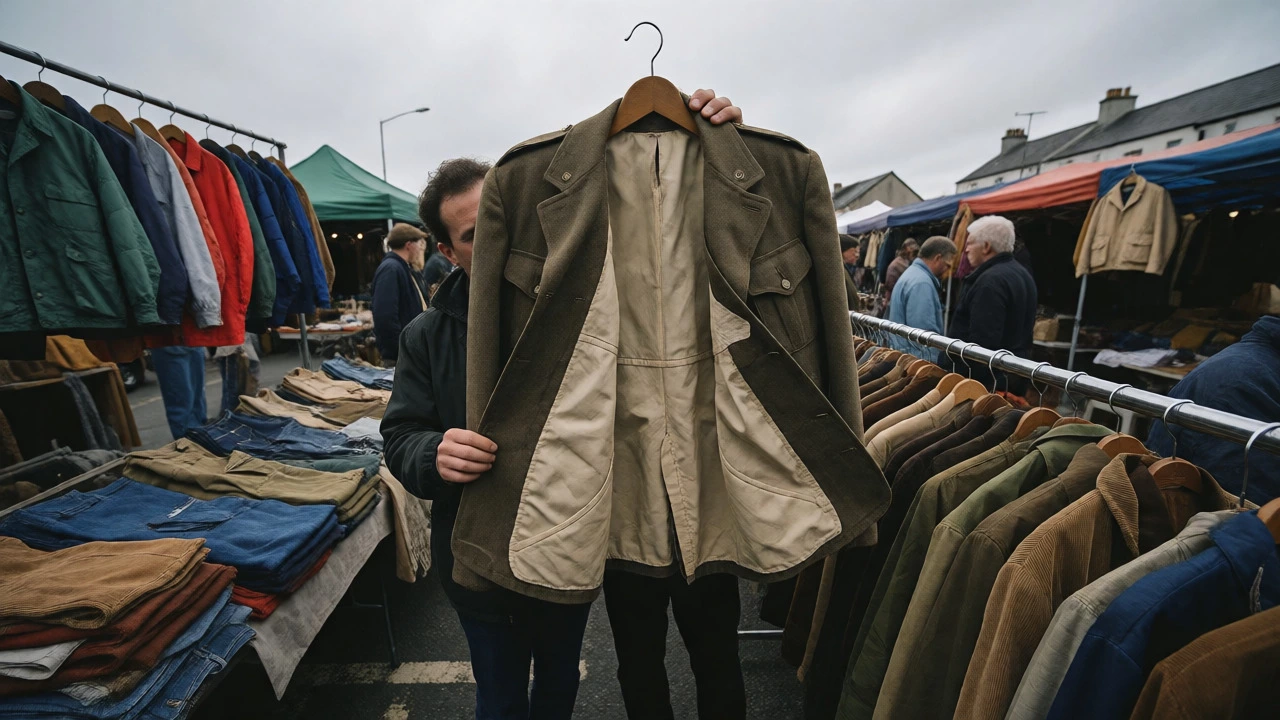
Dating skills are useless if you don’t know where to look. Ireland has a vibrant second-hand scene, but not all sources are equal. Car boot sales across the country, particularly those held on weekends in rural areas outside Galway and Dublin, often yield older stock because they source from estate clearances rather than bulk commercial returns. Charity shops vary wildly; some urban branches receive trendy donations, while regional ones get heirlooms.
Online platforms like Adverts.ie are useful, but beware of sellers who confuse "second-hand" with "vintage." Ask for close-up photos of labels and zippers before committing. If you are serious about collecting, visit specialized vintage boutiques in Dublin’s Temple Bar area or independent stalls in Belfast’s Cathedral Quarter. They often curate by era, reducing the guesswork. Remember, authenticity isn’t just about age; it’s about condition. A 1950s jacket with moth holes might be less valuable than a pristine 1970s piece, unless you plan to restore it yourself.
Frequently Asked Questions
What does "deadstock" mean in vintage clothing?
Deadstock refers to vintage items that have never been worn or used. They still have original tags attached and show no signs of wear. In Ireland, deadstock is rare in charity shops but occasionally appears in estate sales or specialized vintage dealers. It commands a higher price due to its pristine condition.
Are Irish-made jackets easier to date than imported ones?
Not necessarily. While Irish mills like Magee or Harris Tweed producers have documented histories, many jackets worn in Ireland were imported from the UK, USA, or Europe. Local brands like Connolly of England (often sold in Ireland) or specific Irish tailors may have unique labels, but international brands dominate the vintage market. Focus on universal indicators like zippers and care labels first.
How do I clean a vintage jacket without damaging it?
Always test a small, hidden area first. For wool and tweed, professional dry cleaning is safest, especially for structured jackets. Leather requires specialized conditioning creams to prevent cracking. Never machine wash vintage items unless the care label explicitly permits it, and even then, use cold water and gentle cycles. Air dry flat to maintain shape.
Can fake vintage jackets exist?
Yes. Fast fashion brands often reproduce vintage styles. These are not "fakes" in the sense of being counterfeit, but they are not vintage either. Telltale signs include modern synthetic fabrics, serged seams, and lack of aging on buttons or zippers. If the item looks too new for its claimed age, it probably is.
Why do some vintage jackets have no size labels?
Early mass-produced clothing sometimes omitted size labels, or they were printed directly onto the fabric and washed away. Military uniforms often used sizing based on chest measurements stamped internally. If missing, measure the jacket’s pit-to-pit width and compare it to vintage sizing charts, keeping in mind that historical sizes ran smaller than modern equivalents.